Monday, May 23, 2011

Beckett's flawed music

(Samuel Beckett at a Paris bistro.)

When I was young, I identified with every Neil Simon guffaw at the human condition. Yet I was blissfully oblivious to what I thought was every humorless Samuel Beckett observation concerning the ennui that envelopes our lives. Over the decades, a frightening transformation has occurred: Simon's wry comedy has shrunk, while Beckett's clowns "astride the grave" have become massively pertinent and, yes, even morbidly hilarious, as if they were Laurel & Hardy on downers.

Anyone who's ever gotten above a B in Intro to Theater class knows that the Irish, particularly Beckett, are theater's great Yoricks, showing us our foibles and mortality, while amusing and bemusing us with the tinkle of jester bells. "Waiting for Godot" is, in all probability, the most influential and revered play of the second half of the 20th century not written by Eugene O'Neil or Tennessee Williams. One way to regard Beckett's genius is to view him as the polar opposite of Wagner. Whereas the German myth maker utilized his transcendent music to create a massive world of conflicted gods, Beckett employs his bleak poetry to summon a godless universe of parched humans seeking nourishment and meaning in a landscape devoid of illumination.

Beckett's "Endgame," which is receiving a vibrant production at the Cleveland Play House presented by the Cleveland Museum of Art, proves itself to be a weak cousin to the fabled "Godot." In spite of Massoud Saidpour's stately direction and an exceptionally gifted cast, it doesn't take a Sherlock Holmes to detect that the play is a painful 90 minutes with a brilliant 20 minutes buried inside. In Beckett tradition, it is set in a dismal, post-apocalyptic world equipped with archetypal masochistic servant and master and, in a corner in two garbage cans, the master's cast-off, aged parents. To give a whiff of its dark humor, we only have to mention that its master and servant are named Hamm and Clov. Hamm's decaying parents are Nagg and Nell.

The action is confined to Hamm periodically calling out for his pain killer and Nagg and Nell occasionally popping out of their individual cans to ask for a biscuit and to break into tears, which inspires Hamm's observation: "Nothing is as funny as unhappiness." Despite its brilliant writing, there is no dramatic progression, and even though it may get this writer sentenced to literary purgatory, we have to declare that this Beckett work makes one yearn for the same medication that Hamm lusts after. To illustrate the point, the aged professor of literature sitting to my right moaned that he would rather be watching "Lassie Come Home."

(Dorothy Silver as Nell in Beckett’s "Endgame." Photo by Peter Jennings, courtesy the Cleveland Museum of Art.)
Although it is my duty to remind even the most ardent fans of the MGM collie that any Beckett is good for your character, you will rarely see him performed with such brio. Director Saidpour has found the perfect role model for each character. Terence Cranendonk whimsically plays the beleaguered Clov in the manner of Boris Karloff performing the monster mash - endearingly gruesome. Last year, George Roth gave us a thoroughly kosher Tevye and this year is equally effective, in sun glasses and Harpo wig, playing Hamm. One of the great pleasures of being a Clevelander is the enduring excellence of Dorothy Silver. In this, her first Beckett performance, she plays with the melancholy yet elegant woe of an El Greco Madonna. And as her garbage-can husband, Mark Seven evokes the ruined grandeur of a Rembrandt beggar.

Perhaps no writer so defined our post-war blues as Samuel Beckett. Even his flawed music deserves our consideration.

"Endgame" plays until Saturday, June 11. For tickets, call 216-421-7350.

Friday, May 13, 2011

The Little Theater That Could

(Kristi Little and Daniel Caraballo in the Ensemble Theatre production of Ravij Joseph's "Huck and Holden.")
Ever since Julius Caesar almost choked on a grape, guffawing at that now-lost farce about a messy Etruscan rooming with a compulsively neat, neurotic Spartan, it's been endlessly demonstrated that only a handful of plots exist. Judging by the two plays this writer has seen by Rajiv Joseph (no relation), the Cleveland-born playwright seems to have fixated on a "King and I"-"Teahouse of the August Moon" clash-of-cultures motif that he epitomizes as Western-people-funny.

On Broadway, in Joseph's Pulitzer-nominated "Bengal Tiger at the Baghdad Zoo," Robin Williams' star-studded bombast and director Moises Kaufman's thicker-than-molasses metaphysics smother the playwright's gentle humanity. Thankfully, in Ensemble Theatre's lean production of Joseph's first work, "Huck and Holden," his exuberant imagination and delicate scheming emerge unimpeded.

As in the aforementioned "King and I" and so many other works, the play tells of how an arrogant foreigner is defrosted by down-home (here American) virtues, which include liberated sexual mores and a lack of social distinctions. At the same time, the repressed foreigner teaches the American the glories of literature and that sex must be tempered by romance.

Joseph begins his play on a series of delightful ironies and cultural criss crosses: an American college student working in a library, fascinated by the Kama Sutra yet unaware of who Huck Finn and Holden Caulfield are, meets an Indian foreign exchange student who is terrified by sex and every aspect of American life. Utilizing a ghost, an Indian god and several flights of fantasy, Joseph chronicles two cultures liberating each other with all the charm one could hope for in a first play.

"Huck and Holden" is directed by Celeste Cosentino, daughter of Ensemble's late founder, Lucia Colombi. Cosentino began the theater season with an adept production of old-master Horton Foote's "Dividing the Estate." Her season-ending production of Joseph's play is equally skilled, with a cast so good we can't resist calling them adorable - and proving that Ensemble remains the little theater that could.

"Huck and Holden" runs at Ensemble Theatre through Sunday, May 29 at the Cleveland Play House. For tickets, call 216-321-2930.

Monday, May 9, 2011

Curtain Down

(Arthur Laurents, who died May 12 at age 93, wrote two the books for two of Broadway's most indelible musicals, "West Side Story" and Gypsy.")

Last week, Arthur Laurents, one of Broadway and Hollywood's most ferocious and erratic craftsman, expired of pneumonia at the age of 93. For any normal human, this would be the expected conclusion of a long life. However, for a man who had a genius for making collaborators into foes and shaping the mundane detritus of existence into blazing confrontation, this is a yawning disappointment. If Laurents had managed to succumb under mysterious circumstances, his long line of show-biz enemies would have made for a whodunit worthy of Agatha Christie.

His output included screenplays for Hitchcock, an Oscar-winning vehicle for Ingrid Bergman and one of Olivia de Havilland's juiciest roles. Alas, they linger in the twilight of semi-oblivion. The Streisand-Redford "The Way We Were" endures mainly due to its title song, plus Laurents claims it as a bastardization of his original political intentions.

(The gym scene from the touring production of "West Side Story" now at PlayhouseSquare.)

The key to the firebrand's immortality is the pact he made with song and dance in the '50s. With two titanic musicals, "West Side Story" and "Gypsy," he formed a holy trinity with Stephen Sondheim and Jerome Robbins, with inspired music by Leonard Bernstein on the first and Jule Styne on the latter. These are the works that will forever keep his name in crossword puzzles.

If there were no Jet-Shark rumbles, macho men would find snapping their fingers to be a hollow gesture. If Laurents had not had the inspiration to turn Gypsy Rose Lee's mother into a Shakespearean gorgon, torturing her offspring to "sing out" and performing musical monologues of filial betrayal, anguished homosexuals would have no role model on which to pin their mishegas.

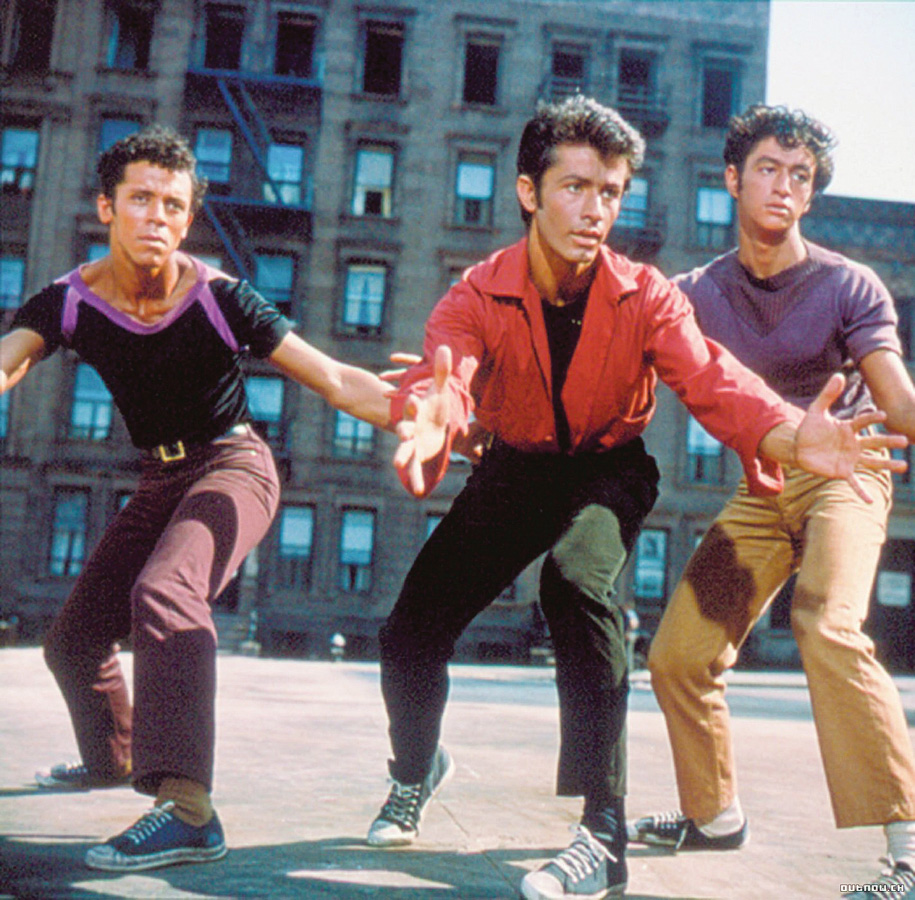
(A scene from the movie version of "West Side Story.")
Together, these works are the peaks of musical drama. Their book writer spent over half a century clinging to them with a tenacity that would make Mama Rose proud. Every few decades, he would reshape and redirect another revival of "Gypsy," and weeks before his death he was badgering Sondheim to let Streisand star in a third filmed adaptation. His last stage project was to try to put what he thought to be some verisimilitude into "West Side Story" by injecting Spanish into the book and lyrics and making the kids raunchier and less poetic. Due to his pathological possessiveness of his two children, he virulently rejected their film versions, ignoring the superb acting of Rosalind Russell's elegantly rendered Rose and Natalie Woods' luminous Maria and moving Gypsy, dwelling ad nauseum on a particular pair of high-heeled pumps Russell wore while performing "Rose's Turn." Concerning "West Side Story," he did astutely point out that the movie was too pretty and weakened by the gross inadequacies of Richard Beymer's Tony.

(Rosalind Russell showing off those fatal pumps in the 1962 film version of "Gypsy.")
But the years have shown that "West Side Story" is akin to an expensive, perfectly designed sports car that often fails to fire on all cylinders, despite Laurents' complaints that the movie seems to have come closest to bringing the show's virtues to fruition. This is amply demonstrated in the touring production currently playing Cleveland's Palace Theatre. Only Robbins' choreography and the romantic and rhythmic sublimity of Bernstein's music are gloriously intact. Laurents appeared to be laboring under the delusion that such realities as feigned masturbation during "Gee, Officer Krupke," the elimination of the indelible moment when the warring gangs put aside their differences to carry of the dead Tony, and T-shirts with holes will imbue the show with a more up-to-date sensibility. Instead, this spoils the pacing and mars the ideal stylization achieved in 1957.

The ultimate irony is that, at the end of Laurents' life, he was the real Mama Rose, unable to leave his brilliant offspring to flourish on their own.

Monday, May 2, 2011

S.S. Company

(Lydia Hall, left, as Jenny; Ursula Cataan as Amy; Connor O'Brien as Bobby; Tracee Patterson as Joanne; Abigail Alwein as Susan; and Megan Elk as Sarah in the Fairmount Performing Arts Conservatory production of "Company." Photo by Kathy Sandham.)
Those with a predilection for kitsch might fondly recall Frank Wildhorn's rock revamp of Dr. Jekyll and Mr. Hyde. On screen, Robert Louis Stevenson's born-in-a-nightmare embodiment of schizophrenia has been most notably split between the talents of John Barrymore, Fredric March and Spencer Tracy. However, the undying parable's most visceral manifestation comes in a 1970 musical by Stephen Sondheim and George Furth known as "Company," now at Fairmount Center for the Arts. It would be nearly impossible in the annals of Broadway to find a work so conflicted between the numbing banality and ersatz hipness of its book and the melodic invention, salient wit and psychological insights of its score.

(Fredric March in the 1931 film version of "Dr. Jekyll and Mr. Hyde.")
We speculate that this strange malady is due to the work's bizarre birth pangs. It is based on a series of vignettes about the vicissitudes of marriage. To draw together these pieces, the creators inserted a neurotic bachelor, Bobby. But ultimately the character, as written, was never more than a cipher who is not interesting enough to be the focal point of the show's disparate parts.

(Spencer Tracy and Ingrid Bergman in the 1941film version of "Dr. Jekyll and Mr. Hyde.")
But, oh, that score. With nods to boogie woogie and rollicking choruses to ballads of alienation and commitment phobia, Sondheim's cornucopia remains startling and fresh even after 41 years. Unless someday there's a rewritten version of the book, there will never be a "Company" you'd want to invite over for dinner.

So perhaps it is appropriate that Fred Sternfeld's Fairmount Performing Arts Conservatory production is dizzyingly erratic, blowing hot and cold - a ship that docks triumphantly in spite of its many leaks. Indicative of the inconsistency is Connor O'Brien's blatantly insincere Bobby. Some may find his performance hollow, but others may relish his life-of-the-party obsequiousness as a justification for his emotional neediness. His original approach comes to fruition when he seems to be dancing to save his soul in "Side by Side by Side."

Among the evening's undisputed highlights is Ursula Cataan's felicitously frazzled Amy in wedding dress and boots victoriously conquering Sondheim's tongue-twisting lyrics in "Getting Married Today." Adding flash to "Another Hundred People," that love-hate ode to New York, is Natalie Green, ready to pack her bags and go on tour as Marta.

Where the production encounters rough sailing is the unexpected faltering of the usually wondrous Tracee Patterson. As Joanne, the musical's bitter fulcrum, Patterson is giving us one of the bleakest showstoppers in all of theater, "The Ladies Who Lunch," a dark reflection of rich, alienated Manhattan life. Sadly, she opts to play up the character's inebriation and winds up defanging the song's gut-wrenching impact.

Still, it is an unanticipated reward to find stellar Sondheim on the proverbial head of a pin in a civic center - get this - next to a Heinen's. It's a paradox worthy of our beloved Steve.

"Company" runs at Fairmount Center for the Arts through Saturday, May 14. For tickets, call 440-338-3171. 440-338-3171

Monday, April 25, 2011

Improvising Your Life

(Dobama Theatre is presenting Annie Baker's "Circle Mirror Transformation" through Sunday, May 15.)
Dobama Theatre ends its season with "Circle Mirror Transformation," a play so warm, humanistic and forthright that you wish it could date your sister. Playwright Annie Baker has come up with the interesting concept of replacing the Bible and Freud with the improvisational theater games of Viola Spolin. The play works as an updated version of "Marty," but instead of seeking companionship in a dance hall, its small-town, lonely denizens take a theater improv class. Set in a community center in Shirley, Vermont, "Circle" chronicles a summer session.

(Ernest Borgnine in the 1955 movie version of Paddy Chavefsky's "Marty.")
The playwright's clever conceit is to reveal the characters' lives through the process of Spolin's games. Baker is particularly adept at capturing the verisimilitude of thwarted lives: a recently divorced man; a high-school girl from an abusive family trying to find the courage to audition for her school's production of "West Side Story"; a kooky actress recovering from a toxic relationship; an aging hippie who never got over the '60s; and, as the teacher, one of those earth-mother Bohemians you can see at any table at Tommy's.

The play is sometimes done in by its own integrity. With dozens of glimpses into the theater process, the work doesn't develop in a conventional manner. Like eavesdroppers in a coffee shop, the audience is force to piece together the minutiae of the characters' lives. This is a process that can be frustratingly slow, but ultimately it pays off by making us privileged voyeurs.

Befitting the script, the cast is especially deft at capturing the universal pain of average people trying to crack the shell of their inhibitions. Director Juliette Begnier, an experienced local actress, shows great sensitivity in finding the delicate pain and joy in this fragmented, but tender work. If you happen to spot someone nearby sans wedding ring who seems to have been moved by the evening's proceedings, fly right to their side and make him/her your own.

Dobama Theatre presents "Circle Mirror Transformation" through Sunday, May 15. For tickets, call 216-932-3396.

Tuesday, April 19, 2011

Paradise Refound

(Alfred Drake and Patricia Morison in the original Broadway production of "Kiss Me, Kate.")
We all have our own special hopes for that Paradise at the end of the tunnel. Muslims dream of virgins, boozers envision hangover-free Martini guisers, fatties fantasize about Godivas that slim the hips, and ponytailed rockers yearn for a Beatles reunion. Then there are those esoteric Mermanites weaned on Sondheim and cast albums who imagine the pearly gates as the entrance to the Alvin Theatre circa 1941.

In this Paradise Refound, Dante has given way to Cole Porter, and here the Broadway spectaculars, raped by Hollywood vulgarians, play in unmiked original-cast perpetuity. In the Art Deco lounge, the TV spectaculars that once delighted Aunt Flo have returned to again spread their kinescope ecstasies. If this be your impossible dream, light the candles and hop in your surrey with the fringe on top. For three musical holy grails have been unearthed and refurbished on DVD. Those of you who remember MGM's surprisingly well-made and faithful "Kiss Me Kate" in 1953 may think of its leads, Kathryn Grayson and Howard Keel, as the equivalent of good, solid technicolor sirloin steak. Five years after the movie, the Hallmark Hall of Fame restored the show's original comma and Broadway leads. If caviar could sing and emote, it would be the performances that Patricia Morison and Alfred Drake gave on the television adaptation of this show in 1958, a decade after its Broadway premiere. Although sadly cut to 78 minutes, every moment reminds us of the delight that the archeologists must have felt when they found the glories that lay hidden for centuries in King Tut's Tomb. Aside from the two leads, we have jazz diva Julie Wilson's incorrigibly naughty take on Lois Lane singing "Tom, Dick or Harry" and Jack Klugman brushing up his Shakespeare a few months before he would join Merman in "Gypsy." Anyone raised on distant legends of Broadway sophistication will find this DVD a key to a lost civilization of giddy elegance.

On a more bizarre note, we have an unlikely meeting of three legends in a 1953 TV production of "Anything Goes." The idea of Frank Sinatra, the idol of saddle-shoed millions, ardently wooing Broadway's own belting Bruennhilde (Ethel Merman) with Porter-ish ardor seems surrealistic beyond the dreams of Groucho. Add to this Dorothy's own Cowardly Lion (Bert Lahr) joining his former "DuBarry Was a Lady" co-star for an interpolated performance of "Friendship." What we have here is the ultimate happy talk - a dream come true.

To top off our triumvirate, imagine a Sondheim-penned episode of "The Twilight Zone" populated by the original Mother in "Life With Father" (Dorothy Stickney), the cinematic Liesl from "The Sound of Music" (Charmian Carr) and a crooning Norman Bates (Anthony Perkins). It's called "Evening Primrose," which aired once on ABC's Stage 67 in 1966. Needless to say, fascinating.

Monday, April 18, 2011

Legacy of the Light-Fingered

(Michelle Duffy, right, as Olivia, confers with Lenny Van Dohlen, as Voltaire, in the Cleveland Play House production of Karen Zacarias' "Legacy of Light." Photo by Roger Mastroianni.)
The Cleveland Play House is on the verge of painting its wagon and hitting the Euclid Avenue trail to its new Allen Theatre digs at PlayhouseSquare. Its final production finds the company in a self-congratulatory state of mind, paying tribute to its own Lady Bountiful - Roe Green. Following the advice of that great oracle, Dolly Levi, Green is "spreading money around like manure to help young things grow." In this case, her fertilizer is providing scholarships for fledgling playwrights. Judging by the Play House's current production, Karen Zacarias' "Legacy of Light," this fund is sorely needed to cultivate a better class of play.

God knows, as playwright-in-residence at Arena Stage in Washington, D.C., and instructor of playwriting at Georgetown University, Zacarias is no novice. Yet the work on stage at the Play House, a "metaphysical" farce spanning two centuries, depicting the plight of two female scientists and graced by the presence of the ghost of Voltaire, shows a penchant for cerebral whimsy and winking ethics lessons that would only be forgivable through your freshman year. Listing the play's grievous sins would consume more than its actual length. But most offensive of all to this audience member is a work that contains the ghost of Voltaire with constant, smug references to "the best of all possible worlds" and yet not a single mention of the greatest posthumous boon ever bestowed on a French philosopher's reputation, Leonard Bernstein's magnificent musicalization of "Candide."

We must admit that director Bart Delorenzo, set designer Takeshi Kata and costume designer David Kay Mickelsen imbue the production with the cheerful plushness of a Martha Stewart layout. The falling Newton apples and Little Bo Peep bodices offer lagniappes to atone for the script's falls from dramatic grace. As to the cast, all second Broadway leads, their Juilliard training is on evident display and they all bear finely tuned bodies and voices that make the peek-a-boo, Beaumarchais-like sex scenes a pleasure unto themselves.

(A scene from the current Broadway production of "Arcadia" by Tom Stoppard - Karen Zacarias' obvious muse.)
 However, the real ghost that haunts the play is not a dead French philosopher but a very-much-alive British playwright, Tom Stoppard. It's ironic that a writer who has made a career of playing with a variety of poets, including Shakespeare and Wilde, finds himself so blatantly imitated. On the Play House stage are constant references to Stoppard's gleeful use of the illustrious deceased, fixation on science and echoes of torrential wordplay. We feel he would not consider this play to be the sincerest form of flattery. If Zacarias can be so obvious in her adulation of Stoppard, this gives me the courage to go back to that epic I've been toiling on for decades - "Pussy on a Glass Streetcar."

"Legacy of Light" runs at the Cleveland Play House through Sunday, May 1. For tickets, call 216-795-7000.